
Best Rat Cage Accessories & Decorations Your Rats Will Love

Buying a great cage for your rats is only the first step to making them a comfortable home. Most of the space within even a large fancy cage is wasted from the rats’ point of view if we don’t do a good job of the interior decoration.
So, what kind of accessories and decorations does a well set up rats’ cage need?
Somewhere to Sleep
Rats will sleep anywhere, including in the middle of the cage floor (which has caused a few heart attacks when I’ve found furry idiots laid out deeply unconscious in a fine impression of a dead animal – they are never impressed by my care in prodding them to check).
However, like us, given the choice they like a nice comfy bed. Each rat will have individual preferences, so I include a few items from each of these groups:
Hammocks
Rats love hammocks. They sit on them, sleep on them and use them as trampolines. They also tend to eat them, which is why about 70% of my hammock collection are cut-price cotton tea-towels.
However, if you want to give your pets a treat, there are lots of options on the market for flat hammocks, bunkbeds, combo hammocks, and tubes.
Boxes and Houses
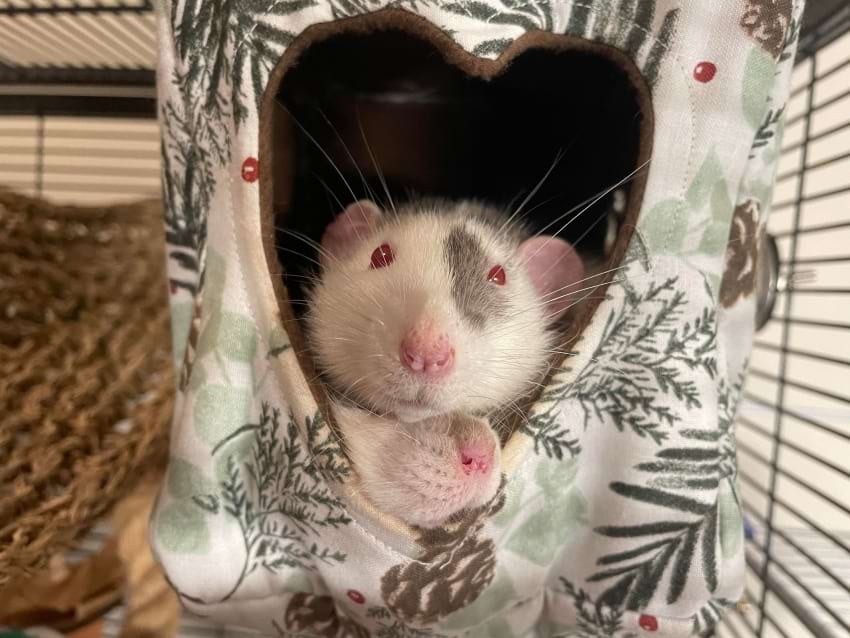
Rats are natural burrowers, so they often like to sleep in an enclosed area. A simple, cheap option is a cardboard box. These need replacing regularly, as the rats both chew them and make them soggy, but they are a fun money-saving option.
For reusable houses, I like sputniks which can either stand on the cage base or clip to the roof, and igloos. Both of these are designed for small animals and have ventilation built in.
Rats often pee in their beds, so any enclosed sleeping area needs enough air holes to prevent ammonia build-up (and cleaning regularly).
Somewhere to Toilet

Despite their sometimes unsavory bedroom habits, rats are naturally clean animals and can easily be litter trained. Key to that is providing a consistent place to toilet, filled with a plain paper cat litter.
I use two types of litter tray:
- corner trays designed for small rodents, and
- simple cheap plastic cat litter trays from the supermarket.
Where to put the litter trays depends on where the rats like to toilet. Having a rather large cage (about 2 m long x 60 cm deep x 1.5 m high / 6.5 ft long x 24 in deep x 5 ft high), I use several! By drilling holes in the corners of the cat litter trays and using garden wire to secure them to the bars, these also make extra shelves to help use the space in the cage.
Food and Drink Accessories
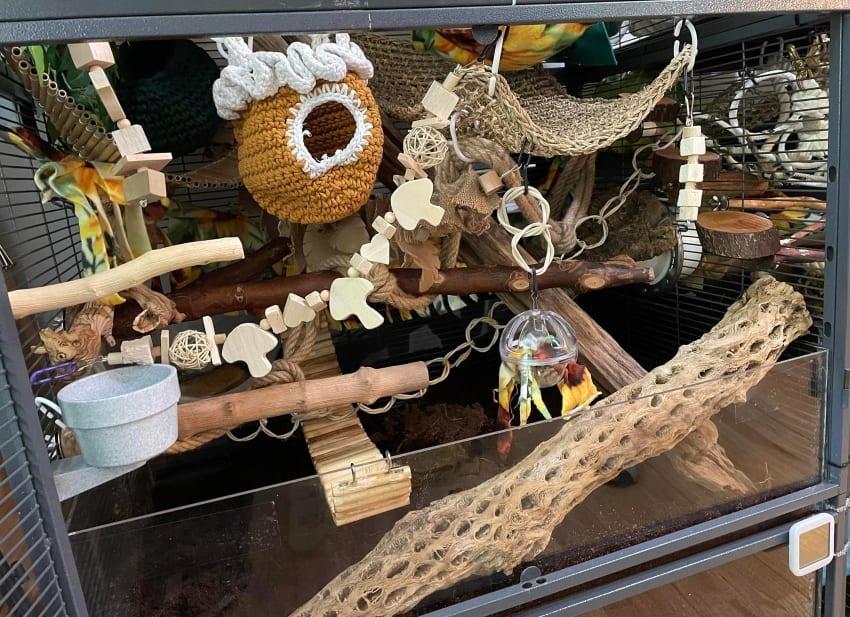
I scatter feed my rats’ food to encourage them to forage. However, if you don’t want to do that, you’ll need food bowls. My favorite are coop-cups as you can fix them to the bars (which helps prevent them being tipped over), and you can position them anywhere in the cage.
The required bowl size depends on how many rats you have, while the fitting depends on your cage type. I use ones with hook attachments for cages with horizontal bars, and screw attachments for vertical bars.
Not all food has to come in a dish. I like to use a kabob (minus the bell…) for vegetables, hung in different parts of the cage. It makes feeding time more interesting and more challenging.
I often put a coop-cup of water in my cage for the rats to play with (they love washing their noses in it). However, it doesn’t stay clean long, so it’s an extra, not their main water source.
The best way to give rats drinking water is from bottles attached to the outside of the cage. I use a basic plastic type on most cages, and glass if I have rats who like to chew the bottles through the bars, or if I need to put the bottle inside the cage. I favor the Pet One brand as I’ve found it drips least, but you may have to try a few local brands to find the one that works for you.
Lots of Places to Play
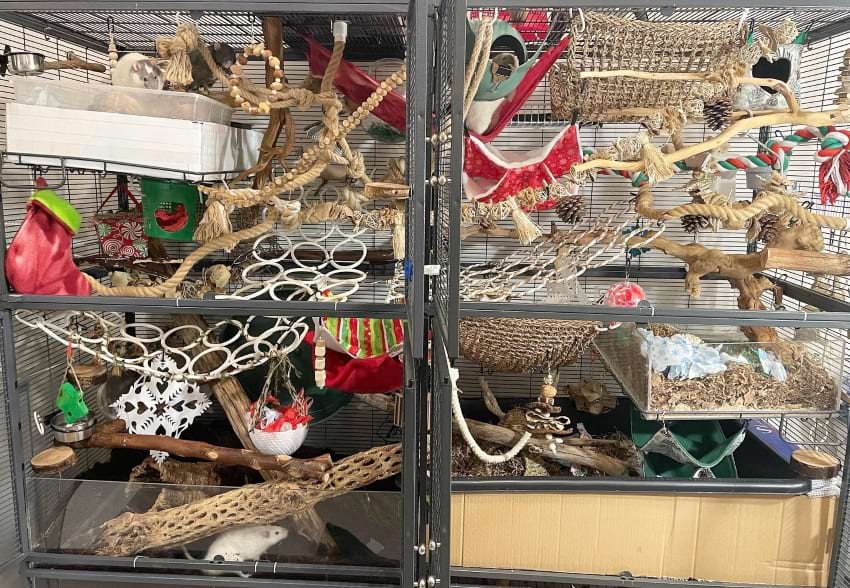
Rats love to play and explore and bounce around. So a good cage layout is one that lets them get active. Options include:
Ropes
I love ropes for my rats and use them instead of ladders. They help keep rats fit by encouraging climbing and balancing. Because they are flexible, they are great for stretching across a cage and filling the central areas that can otherwise end up as dead space.
I buy ropes designed for birds as these have the best range. Types I use include:
- spiral coils – my favorite, although I remove any bells or dangly bits, and use wire to attach both ends to the bars,
- straight perches,
- and hoops (again, I fix both ends to the bars with wire so it is firm rather than a swing).
Wheels
Rats tend to divide into those who ignore wheels and those who spend hours running. They are more likely to use them if they have had access since they were babies.
When choosing a wheel, safety is the priority. For rats, wheels should be a minimum of 30 cm (12 inches) in diameter to avoid damage to their spines and tails, and they should be made of solid plastic or solid metal. If a wheel has an open grid or bars, tails and toes can become caught and injured. My previous wheels have been silent spinners.

Tubes and Tunnels
With their love of burrowing, rats love a good tube. They use it for sleeping, hiding, chasing friends through, and sitting in to watch the world go by. I use two types:
- industrial drain pipe from the local hardware store cut to size,
- and plastic tubes designed for small animals.
The latter are unfortunately getting harder to find in sizes suitable for rats. Most tubes are designed for hamsters and too small to use safely. It is worth keeping an eye out for local second-hand bargains.
Space Fillers
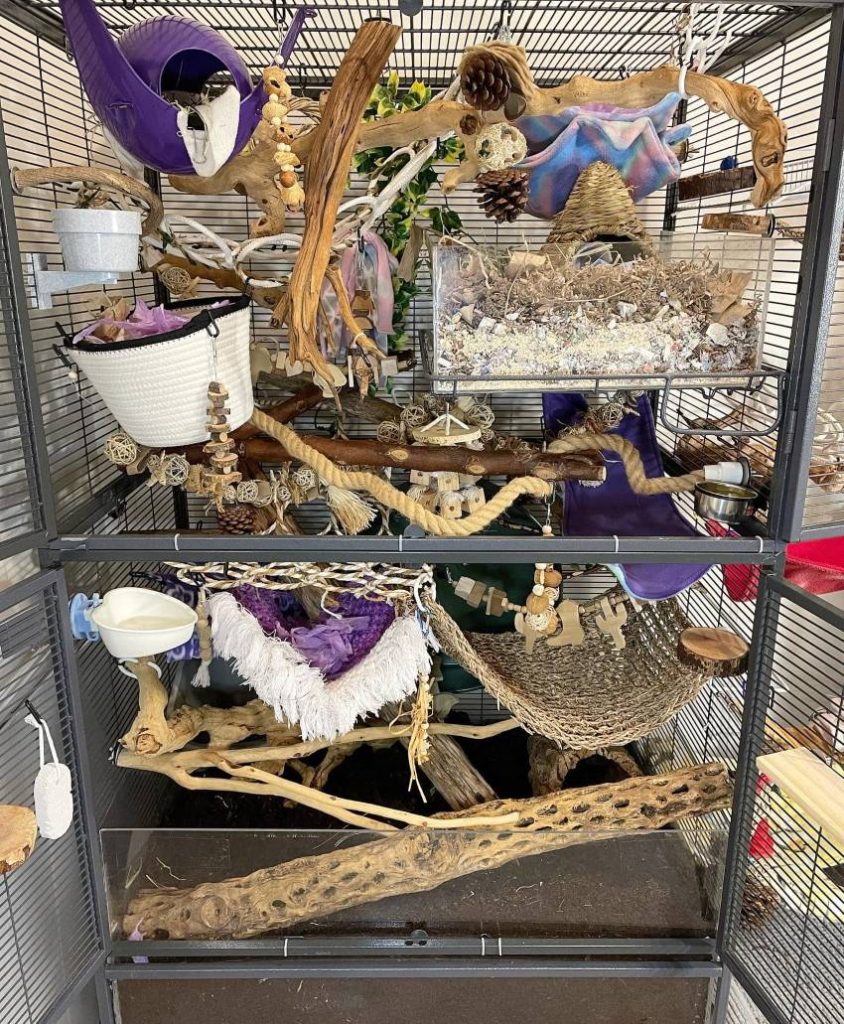
A cage doesn’t want to be so crammed full that the rats can’t stretch out and jump around, but it also doesn’t want any dead space. To fill that and to add in more places to play and sit, I use perches and small plastic boxes. A lot of these are home-made wooden perches, or repurposed plastic storage boxes and trays.
As long as we think about safety in cage decoration (e.g. make sure rats can’t get heads or legs stuck in or between things, there are no sharp bits that could hurt them, nothing toxic, and no big falls), we are only limited by our imagination.
What kind of rat cage accessories and decorations do you use?
Let us know in the comment!



Thank you for your wonderful advice
We’re glad you found it useful 🙂
Thanks, I was thinking of getting a big thick rope for then to climb up but I wasn’t sure if they would like that. You telling me they would love if helps.
We just got 3 rats and have a hard time finding inspiration and guidance on how to utilize the space in our critter nation cage effectively! Thank you so much, your blog posts are the greatest we have found and we have subscribed to your rat newsletter!
Thank you for your wonderful comment, it means a lot 🙂
I noticed lots of wooden sticks and lots of toys made out of wood as well as ropes. I’ve tried searching for them on Amazon but can’t seem to find any that are a match. Any advice?
Hi, I suggest searching for “bird perches” and “bird toys” in stores like Amazon and Chewy instead of things for rats as you’ll get a bigger selection. You can also find rat cage enrichment on Etsy and stores like makeyourownbirdtoys.com.
This is great information! Could you send me details for the acrylic box that is on the right side of the cage (it appears in two different photos – one in the top right quadrant and another in the bottom right quadrant) and also the metal box as well?
Thank you!